vetting supplement brands
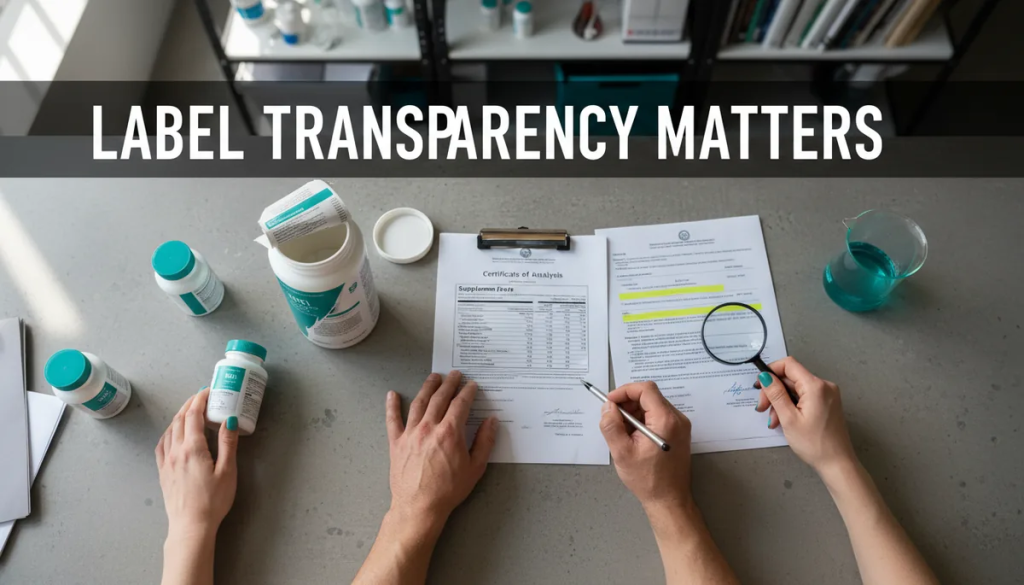
Vetting Supplement Brands with Label Transparency and Third-Party Testing
When choosing supplements, marketing can blur the line between hype and quality. This practical framework helps health-conscious consumers and fitness enthusiasts evaluate brands by reading labels, accessing third-party testing (COAs), and using clear checklists to separate claims from verifiable product quality. ⏱️ 6-min read
Understanding label transparency and why it matters
Label transparency means a product lists full ingredients with exact per-serving dosages, clear sourcing or origin notes where relevant, allergen statements, and storage/expiration information. A transparent label gives you the facts needed to assess safety and effectiveness instead of relying on buzzwords or vague claims.
Transparency matters because:
- Safety: Exact dosages and allergen details reduce the risk of accidental overconsumption or allergic reactions.
- Efficacy: You can match ingredient amounts to what clinical studies used, rather than guessing from marketing copy.
- Contaminant risk: Knowing the ingredient source and testing practices helps identify potential heavy metal, pesticide, or solvent exposure.
- Comparison: Clear labels let you compare products objectively across brands and formulations.
Third-party testing and how to access COAs
Third-party testing is independent laboratory analysis that confirms identity, potency, and absence (or acceptable limits) of contaminants. Certificates of Analysis (COAs) are the documents that report these results for specific batches.
Common COA contents
- Identity testing: confirms the ingredient is what the label claims (e.g., specific herb or extract).
- Potency: measured amounts of active ingredients per unit or per batch.
- Contaminant panels: heavy metals (lead, arsenic, cadmium, mercury), pesticides, mycotoxins, and residual solvents for extracts.
- Microbial testing: total aerobic count, yeast, mold, and pathogens.
How to locate and interpret COAs
Practical steps:
- Check the product page for a “COA,” “lab test,” or “batch test” link. Brands that publish COAs often provide them on the product page or a transparency hub.
- If you can’t find a COA, contact customer service and request the COA for the specific batch number printed on your bottle or box.
- Verify the COA batch number and test date match the product you have or plan to buy.
- Scan the COA for identity, potency, and contaminant results. Confirm the measured amounts match the label’s per-serving dosages or declared ranges.
- Look for explicit pass/fail thresholds and lab accreditation (ISO/IEC 17025) or an independent testing lab name.
Recognized certifications to trust
Some certifications add credibility because they require audits and routine testing. Key ones to look for:
- USP Verified — verifies ingredient identity, potency, dissolution (when applicable), and contaminants for specific products.
- NSF Certified for Sport — screens for banned substances and ensures accurate labeling; geared to athletes.
- Informed-Choice / Informed-Sport — regular testing for banned substances and facility auditing for sports supplements.
- BSCG (Banned Substances Control Group) — similar to the above with batch testing and certification seals.
- GMP (Good Manufacturing Practices) — indicates audited manufacturing processes, though not all GMP labels include product-level testing.
Limitations: certifications verify processes, certain tests, or sport-safety, but they don’t guarantee every claim on a label. Use certifications as one data point in side-by-side comparisons rather than a sole decision-maker.
Red flags that indicate low transparency
Watch for these warning signs when evaluating a brand or product:
- Proprietary blends that hide individual ingredient amounts — you can’t assess effective dosing.
- Vague language such as “natural flavors,” “plant-based,” or “proprietary extract” without specifics on source, part of plant, or standardization.
- No COAs available, or COAs provided only on request without batch-specific details.
- Inconsistent serving sizes across similar products or frequent formulation changes without notice.
- Missing allergen information (e.g., “manufactured in a facility that also processes tree nuts”) or unclear vegan/vegetarian status.
Quality and sourcing: what to check beyond the label
Labels are a starting point; quality often depends on where and how ingredients were grown, harvested, and processed.
- Ask for sourcing details: country of origin, supplier names, or whether raw materials come from audited farms. This is especially relevant for botanicals, fish oils, and proteins.
- Prefer organic or non-GMO certification when pesticide residues are a concern, and look for soil- or water-testing reports where available.
- Confirm contaminant testing for heavy metals and pesticides and check that the reported concentrations fall well below regulatory or industry thresholds.
- Look for supplier audits or third-party raw material testing (not just finished-product testing) when possible.
Ingredient considerations by goal
Match ingredient dosages to the goal you care about and look for the evidence-backed ranges. A few practical examples:
- Energy: Caffeine is effective at 100–300 mg per dose for alertness; watch for additional stimulants and total daily intake.
- Athletic recovery/performance: Creatine monohydrate is typically effective at 3–5 g daily; protein powders should list grams of protein per serving and amino acid profile.
- Immune support: Vitamin D3 dosing varies by baseline levels, but many supplements provide 1,000–2,000 IU; look for clear cholecalciferol labeling and batch testing for potency.
- Gut health: Probiotics require strain-level identification and CFU counts at time of expiration or use (not just at manufacture); multi-strain formulas should list strains by name.
- Hormonal balance: Botanicals and adaptogens (e.g., ashwagandha) should be standardized for active constituents and show evidence-based dosing ranges rather than vague extract claims.
Also verify allergen controls, vegan/vegetarian compatibility, and that the product is free from banned substances if you compete in sports.
How to compare brands: a practical vetting checklist
Use a side-by-side template to compare candidates quickly. Capture these fields for each product:
- Label transparency: full ingredient list, per-serving dosages, serving size clarity.
- COA availability: batch-specific COAs accessible publicly or on request; lab accreditation.
- Certifications: USP, NSF Certified for Sport, Informed-Choice, BSCG, GMP, etc.
- Sourcing: country of origin, supplier audits, organic/non-GMO status where relevant.
- Testing frequency: regular batch testing vs. spot checks.
- Customer policies: returns, expiration dating, customer service responsiveness.
Prioritize brands that offer open COAs, consistent batch testing, clear ingredient dosages, and transparent supply chains. Use the template to score or rank brands before you buy.
Step-by-step vetting workflow you can use today
Follow this 6-step process the next time you evaluate a supplement:
- Gather product labels: take screenshots or save product pages and note batch/lot numbers if you already own the product.
- Request or fetch COAs: look on the website or email customer service for the COA tied to your batch number.
- Review certifications: confirm any seals on the label and cross-check with certifier directories when possible.
- Verify sourcing and manufacturing: ask where key ingredients are sourced and whether suppliers are audited; confirm manufacturing facility GMP status.
- Compare to the literature: ensure active ingredient amounts match evidence-based dosing for your goal, and check for clinically tested forms (e.g., methyls vs. folic acid when relevant).
- Prepare a short justification: record your conclusion (buy, monitor, avoid) with reasons and keep this entry in a living file for future reference and to monitor recalls or new COAs.
Keeping a living record makes repeat vetting faster and helps you spot trends, such as a brand improving transparency or repeatedly failing batch tests.
For more information please visit: natural health supplementsTags: label transparency, third-party testing, supplement brands